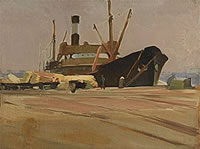
• Fishing Boat at Quayside, circa 1910 -
    Send image Biography Sold


    Presentation: Framed
    SN: 138
    Oil on panel, 9½ x 12¾ ins. (24.2 x 32.4 cms.)
    Provenance: the artist's wife, Betty Malam, and thence by descent

    This painting probably depicts the quayside at Scarborough. Rollinson lived and worked in East Yorkshire throughout his life and found in its landscape and people an endless source of inspiration.
  • The Artist's Wife, Betty Malam, circa 1922 -
    Send image Biography Sold


    Presentation: Framed
    SN: 139
    Oil on canvas, 32 x 20 ins. (81.3 x 50.8 cms.)
    Provenance: the artist's wife, Betty Malam, and thence by descent

    In 1922, Rollinson married one of his students, Betty Malam, an accomplished artist and miniaturist in her own right and the model for this painting. This portrait, which remained with the artist throughout his life, and dates to the time of the marriage, captures the intimacy which clearly existed between artist and model.
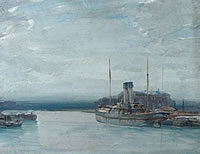
  • Twilight - twin funnel steamer -
    Send image Biography Sold


    Presentation: Framed
    SN: 140
    Oil on panel, 11 x  14 ins. (29.2 x 35.5 cms.)
    Provenance: Eleanor Malam, the artist's wife

    Throughout his life Rollinson, who lived in Cottingham, East Yorkshire, painted the Humber estuary. Here a steamer is shown in a creek or at the mouth of a river, suggesting a tidal harbour such as Grimsby or Hull. The buildings behind the ship appear to be warehouses or a customs house. There is a barge in the picture suggesting that goods were taken to this place for transhipment downriver.

    The ship, pre-World War I in construction, appears to be a short passage cargo steamer, possibly with room for a few passengers, typically used for crossing the North Sea and Channel. The black tops of (yellow?) funnels (hard to judge in the twilight) suggest ownership by a railway company, probably the Great Central, who poured a lot of money into its shipping line and built its own docks at Immingham (near Grimsby). From here they traded across the North Sea to the Baltic, Germany, Holland and Belgium: coal out and pit-props back was one of their mainstays.

    The ship in the Sunderland Rollinson painting might be the Marylebone or the Immingham, both built for the Great Central Railway’s Grimsby-Rotterdam service in 1906. They were built originally as twin-funnelled turbine steamers, but re-engined a few years later with one funnel.  Rollinson moved to Cottingham in 1910, so this picture is likely to have been painted soon after – certainly before WW1.


    We are grateful to Ian Jack for his assistance.
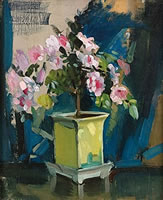
  • Camellia, mid 1920s -
    Send image Biography Sold


    Presentation: Framed
    SN: 141
    Oil on panel, 16 X 13Q ins. (41.6 X 34.3 cms.)
    Provenance: Eleanor Malam, the artist's wife

    Rollinson's lavish technique owed much to the continental nineteenth-century tradition, which remained a staple part of reactionary painting in Britain in the first half of the twentieth century.
  • Fireworks over Scarborough, 1894 -
    Send image Biography Sold


    Presentation: Unmounted
    SN: 968
    Signed, dated and inscribed 12 Princess Street, Scarborough,
    Gouache on card
    10 x 7 in. (25.5 x 18 cm)

Thumbnail panels:
Now Loading